Tuesday, April 1, 2025

Viburnum spp. – Viburnum (بُفرا یا جھاڑی گل)


                Scientific name - Viburnum continifolium. Shrubs or small trees. Vuburnums make garden       beautiful with structures, flowers and berries of different colors - red, pink, blue, purple and black depending on their type and maturity. Full sun mostly for flowers and berries. not very picky about soil. Deciduous. First year growth slow. Watering in morning avoids fungal risks, deep watering weekly. Soil should be moist but not waterlogged.  

Viburnum spp. – Viburnum (بُفرا یا جھاڑی گل)

– Hardy ornamental shrub or small tree
– Fragrant, white to pink clustered blooms
– Versatile landscape plant with year-round interest


🌿 Botanical Name: Viburnum spp. (vy-BUR-num)
🌿 Family: Adoxaceae (a-dox-AY-see-ee)
🧊 Hardiness Zone (USA): 4–9 (varies by species)
📏 Height: 5 to 15 feet; depending on variety – upright or spreading form

🍃 Foliage:
Broadleaf deciduous or evergreen, depending on species; most have oval to elliptical leaves with textured veins and rich green color turning to red, orange, or purple in autumn

🌸 Flowering Period (Lahore/Punjab):
February to April – fragrant white or pale pink flowers bloom in domed or snowball-like clusters; some varieties rebloom lightly in summer

🌼 Companion Plants:

  • Spiraea japonica – for layered shrubs with pink summer flowers

  • Lagerstroemia indica – contrast with crepe-textured blooms

  • Nerium oleander – tough flowering shrub for similar usage

🏡 Garden Usage:
Perfect for hedging, foundation planting, informal screens, or woodland borders; appreciated in both formal and naturalistic gardens for multi-season appeal

🍈 Fruition:
Most viburnums produce small red, blue, or black berries after flowering; attractive to birds and often long-lasting on branches

🌱 Soil:
Tolerates various soils but thrives in fertile, moist, well-drained loam enriched with organic matter

⚖️ pH Value:
5.5–7.5 (acidic to neutral to slightly alkaline depending on variety)

💧 Water:
Moderate; consistent moisture in growing season is best; mulch helps retain soil moisture and cool roots

🌡️ Temperature:
Thrives in Lahore’s winter and spring; tolerates summer heat if partially shaded and well-watered; evergreen varieties may scorch in extreme heat

☀️ Location Preference (sun or shade):
Full sun to partial shade – best flowering and foliage color in at least 4–6 hours of sun

🌾 Propagation:
By softwood cuttings in early summer or hardwood cuttings in winter
Some varieties can be grown from seed, but seeds require moist stratification and patience; germination can take over a year

🐛 Pesticides:
Generally pest-free; aphids or powdery mildew may occur in humid conditions—use neem oil or mild fungicides as needed

🌻 Fertilizers:
Apply balanced fertilizer (10-10-10) in early spring before flowering; compost mulch also supports healthy roots and blooms

🦋 Attractiveness to Wildlife:
Flowers attract bees, butterflies, and other pollinators; fruits are a food source for birds in late summer and fall


💡 Tip:
With its fragrant flowers, vivid autumn foliage, and bird-attracting berries, Viburnum is one of the most rewarding multi-season shrubs for gardens in Lahore’s climate.

🌼 May you enjoy planting, pruning, and appreciating this lovely Viburnum (بُفرا یا جھاڑی گل) as it brings form, fragrance, and function to your landscape year-round.


Solandra maxima- Cup of gold vine


Solandra maxima – Cup of Gold Vine (سونے کا پیالہ بیل)

– Giant golden trumpet flowers, – Night-scented climber, – Fast-growing and evergreen


🌿 Botanical Name: Solandra maxima (soh-LAN-drah MAK-sih-mah)
🌿 Family: Solanaceae (soh-luh-NAY-see-ee)
🧊 Hardiness Zone (USA): 9–11
📏 Height: 20 to 30 feet as a climber

🍃 Foliage:
Broad, leathery, deep green evergreen leaves; new growth appears soft and pale, adding contrast throughout the year

🌸 Flowering Period (Lahore/Punjab):
February to June – large, goblet-shaped golden-yellow flowers that open in the evening and give off a sweet vanilla scent

🌼 Companion Plants:

  • Bougainvillea – adds dramatic, vivid color contrast

  • Tecoma stans – similar sunny disposition and shape

  • Thunbergia grandiflora – adds a cool blue balance to the palette

🏡 Garden Usage:
Ideal for trellises, boundary walls, gazebos, and large containers with structural support; eye-catching and tropical in feel

🍈 Fruition:
Occasional oval, leathery fruits may appear after flowering, though they’re rarely seen in ornamental settings and not harvested.


🌱 Soil:
Loose, fertile, compost-rich loamy soil that drains well

⚖️ pH Value:
Neutral to slightly acidic (6.0 to 7.0)

💧 Water:
Keep evenly moist during spring and summer; reduce in winter; avoid soggy soil

🌡️ Temperature:
Thrives between 20–35°C; vulnerable to frost and cold winds

☀️ Location Preference (sun or shade): Full sun to partial shade – needs minimum 4–6 hours of direct light for optimal flowering

🌾 Propagation:
Easily propagated from semi-hardwood cuttings taken in spring or early summer.
Seed propagation is uncommon in gardens, but viable seeds can be sown in warm, moist soil. Germination takes 3–4 weeks under high humidity.

🐛 Pesticides:
Susceptible to aphids, spider mites, and mealybugs; neem oil or insecticidal soap recommended for control

🌻 Fertilizers:
Balanced fertilizer (10-10-10) monthly in growing season; add compost or leaf mold to enrich the soil

🦋 Attractiveness to Wildlife:
Sweet-scented blooms attract night pollinators such as moths, especially in warmer months


💡 Tip:
With its bold golden chalices and rapid climbing habit, this vine turns any wall or frame into a glowing tropical arch—just be sure to give it room and regular trims.

🌼 May you enjoy planting, watching, and delighting in this Cup of Gold Vine (سونے کا پیالہ بیل) as it blooms richly in your garden or courtyard.


Please enjoy viewing and decorate environment with this creeper. 
Good luck. 

Wednesday, December 16, 2020

Dypsis decaryi, Triangle palm

Botanical name is Dypsis decaryi, phonetics- (DIP-sis), (de-KAR-yee). It belongs to family of Arecaceae family (ar-ek-AY-see-ee). Common name is Triangle Palm. Other name is Neodypsis decaryi. Origin is from Madagascar. USA Hardiness Z – 9- 11. Needs average water and full sun. Drought tolerant besides sweltering heatIt can achieve a height up to 15-20 feet. Could be grown outdoors and in containers. Can grow in poor/ dry soils but well drained. Soil ph, neutral to mildly acidic.  germ 1- 2 months. 

The inflorescence emerges near the base of the lower leaves in the springtime and can grow up to 5 feet long. It's seeds/ parts are poisonous. 

Ornamental use is because of its uniquely arranged leaves base, that forms a triangle at the base. Used as accent plant in residential landscapes. Grown in beds, borders, patio, container. Propagation by seed. Resistant to pest. Fertilize twice a year. 

Grown for foliage, which is blue green in color.

Growth rate is considerably fast. 

It's maintenance is low. No pruning is required. 

The inflorescence emerges near the
base of the lower leaves

Each fruit is one inch long, egg shaped,
green when immature and yellowish-white when ripe.

Nightscape.

In the bays of car parking.

Growth rate is considerably fast. 

Please enjoy reading, viewing and decorate environment with this carefree palm. Good luck. 

Tuesday, December 15, 2020

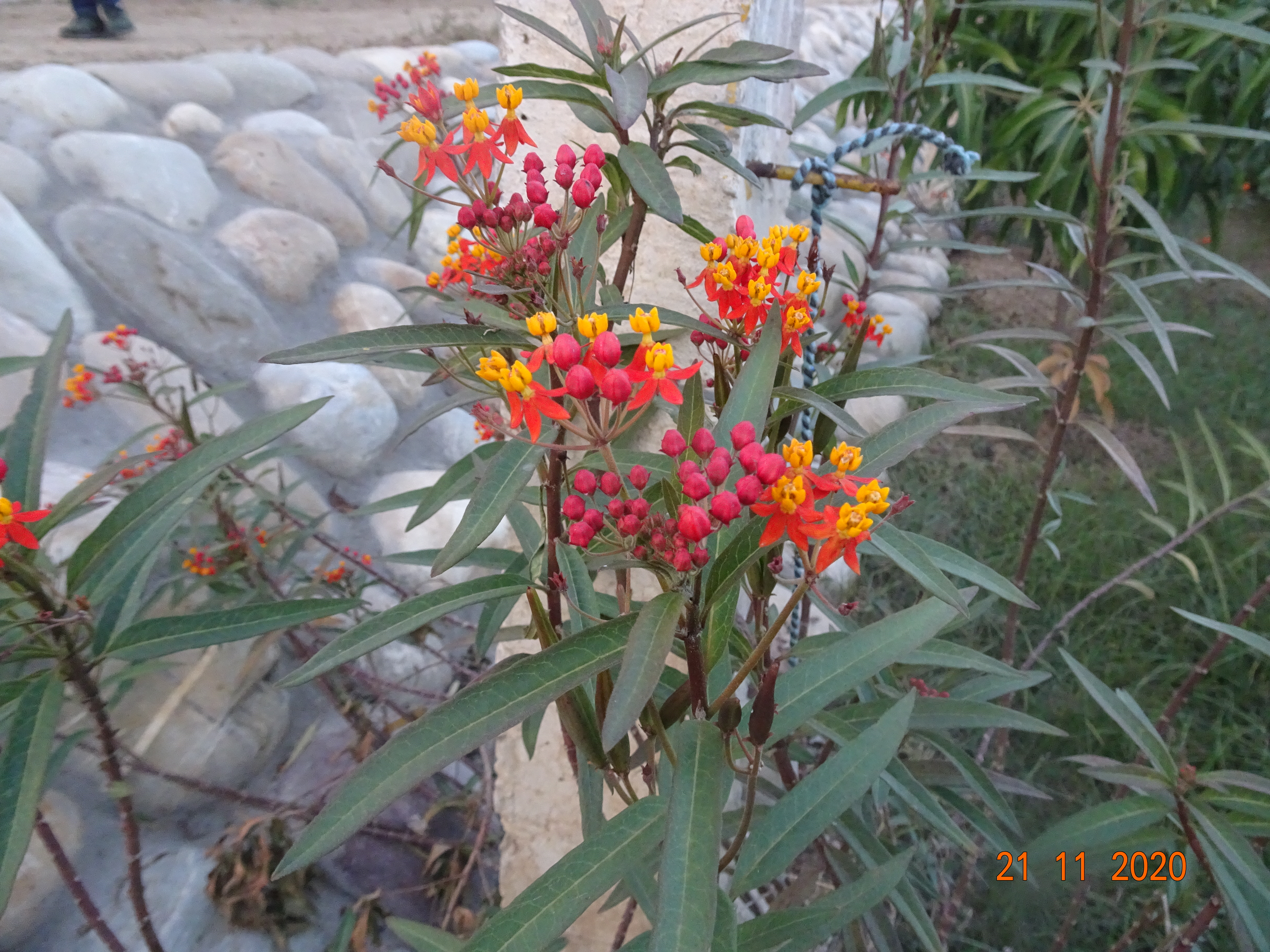
Asclepias curassavica, Mexican Butterfly Weed,

Botanical name is Asclepias curassavica, phoenetics- (ass-KLE-pee-us) (ku-ra-SAV-ik-uh). Common names are Tropical Milkweed, Mexican Butterfly Weed, Scarlet Milkweed and Blood Flower. Belongs to family of Apocynaceae (a-pos-ih-NAY-see-ee). It is native to the American tropics. Hardiness USA Zone : 8- 11.Type is Tropicals and Tender Perennials.

Height-18-24 inches. Thrives well under full sun. Leaves are about 5 inch long, elliptic and pointed at both ends. Attracts, Hummingbirds, butterflies and bees. Grows best in light, rich, evenly moist, well-drained soil. Soil ph neutral or mildly acidic. Use gloves as sap is toxic to human skin. 

Propagation from seeds, by dividing rhizomes, including offsets. Properly cleaned seeds can be successfully stored. When it seems to have died... it always comes back. Used in beds, borders, cottage gardens, meadows, butterfly gardens and a good cut flower. 

Named after Greek god Asklepios the god of medicine.

An erect, evergreen perennial subshrub. 

Bloom is red-orange in color, blooms
continuously from spring until autumn.

Foliage is herbaceous and blue-green in color. 

No serious insect or disease problems. 

Average water needs. 

Low in maintenance. 

Poisonous to livestock.

Please enjoy reading, viewing and growing this blood flower.

Sunday, November 15, 2020

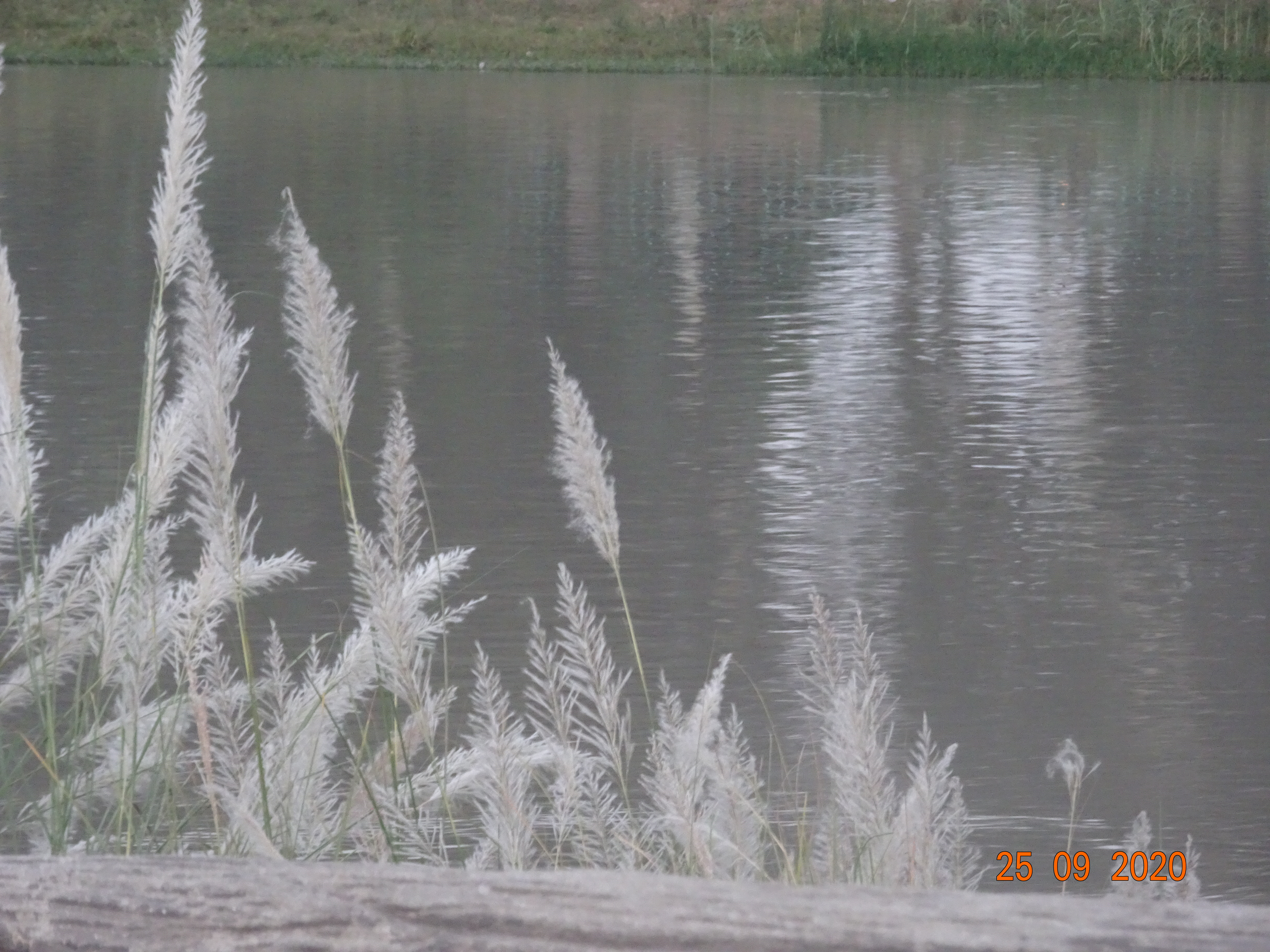
Saccharum spontaneum, wild sugarcane

It's botanical name is Saccharum spontaneum.  Common name is Wild Sugarcane. Phonetics- (SACK-er-um , spon-TEH-nee-um). It belongs to Poaceae  (poh-AY-see-ee) - grass family. Native to South Asia. It has rhizomatous roots. 

Leaves are harsh and linear. Inflorescence are plumose panicles, white and erect. Flowers and fruits at the end of the rains, it helps in farming colony besides roots. Root-system is extremely extensive and used as a sand binder to reduce soil erosion. Helps in dune stabilization. Found near swamps, along canals, roads and railway tracks. 

Has several uses; reeds are made into mats, screens, and thatch roofs. Ash is used as salt substitute. 


It is a perennial grass with 2-4 meters in height.

A plant with white inflorescence.

Young inflorescences, can be taken raw,
steamed or roasted. 

Used for screening and hedging. 


Flowers from July- October


Animal fodder during scarcity.  

A good mulching material.

A source of sugar, peeled rhizomes
have a sweet flavour.  

Propagation is done vegetatively
or from seed. 

Habituates along water channels and swamps.

Please enjoy reading, viewing and cautiously adding into your landscape. 

Tuesday, November 3, 2020

Alstroemeria aurea, Peruvian lily

Alstroemeria aurea, commonly called Peruvian lily and Lily of the Incas. Phoenetics- (al-stre-MEE-ree-uh) (AW-re-uh). 

A tuberous perennial. Family Alstroemeriaceae. Origin, Argentina and Chile. USA Hardiness Zone: (7 to 10). Height 1 to 3 feet, spread, 1 to 2 feet. Water requirement and maintenance are medium. Disease free. 

Soil should be organically rich, medium moisture, well-drained in sunny locations. Plant naturalizes through creeping roots and form colonies. Used as commercial cut flowers. Border or accent and for mass display.  Large container plant. Poisonous when ingested, or allergic to skin. 

Propagation from seed; stratify if sowing indoors. By dividing rhizomes, tubers, corms or bulbs (including offsets). 

Photos have been taken by me from Lahore. 

Showy flowersBloom time: March to June.

Bloom colors are many,
with spotting and streaking. 

Reliable and easy to grow. 

Pull stem from the base for more blooms
and don’t cut.

Attracted to bees, butterflies and birds.

Deadhead the spent flowers. 

Narrow, twisted, lance-shaped leaves up to 4" long.  


Please enjoy reading, viewing and planting these easy colors to your gardens. 

Monday, November 2, 2020

Plumeria pudica- Bridal Bouquet

Plumeria pudica- (ploo-MEER-ee-a) (pud-EE-kuh). Other names are; Bridal Bouquet, Fiddle Leaf, White Frangipani and Wild Plumeria. Belongs to Apocynaceae, family. Native to Panama, Colombia. USA hardiness zone- 9- 11.

Perennials, shrubs or small Trees. Tropical, tender perennials. Height-  6- 8 feet, spread 4-6 feet. Mildly fragrant, appears as white bouquet. Used as cut flower cuttings, Deciduous. 

Easy to grow. Water summers 10 to 15 day, winters 4 weeks. Fertlize during warmer months. Soil ph neutral/ slightly acidic. 

Leaves are dark green. Unique fiddle/ spoon-shaped, beauty in both leaves/ flower. Propagation- cuttings, let thee get callous, seeds –store not well. Tie bags to tree for seed.  

All photographs are taken by me from Lahore. 


Mildly fragrant, appears as white bouquet.


No serious pest/ disease issues.

Bloom time, late spring to early winters.

Bloom color is white/ near white,
with 
yellow center.

 
Grows under sun to partial/ light shade. 

Somewhat drought tolerant. Needs well drained soil.

Unique shape of leaves, like a spoon/ fiddle.

Please enjoy reading, viewing and adopting this lovely white bouquet with spoon leaves.